✉️ Not subscribed yet? Subscribe to the Newsletter
Feeling of Computing Weekly 2026/04 Week 2
2026-04-13 09:59
🧑💻️ RISC-V Linux BusyBox Single Board Computer 📑️ Federated Wiki 📐️ Parametric SVG
linking-together
💬 Geert Roumen: Spatial Pixel
Super cool work by Violet Whitney and William Martin on spatial computing with some llm to “speak human” with artificial intelligence and spatial computing. Think mixed reality without the glasses.
share-your-work
💬 Duane McLemore: Train Trees
I can't take credit for anything here, it's all Claude's doing. But I wanted to share because I thought you all might enjoy.
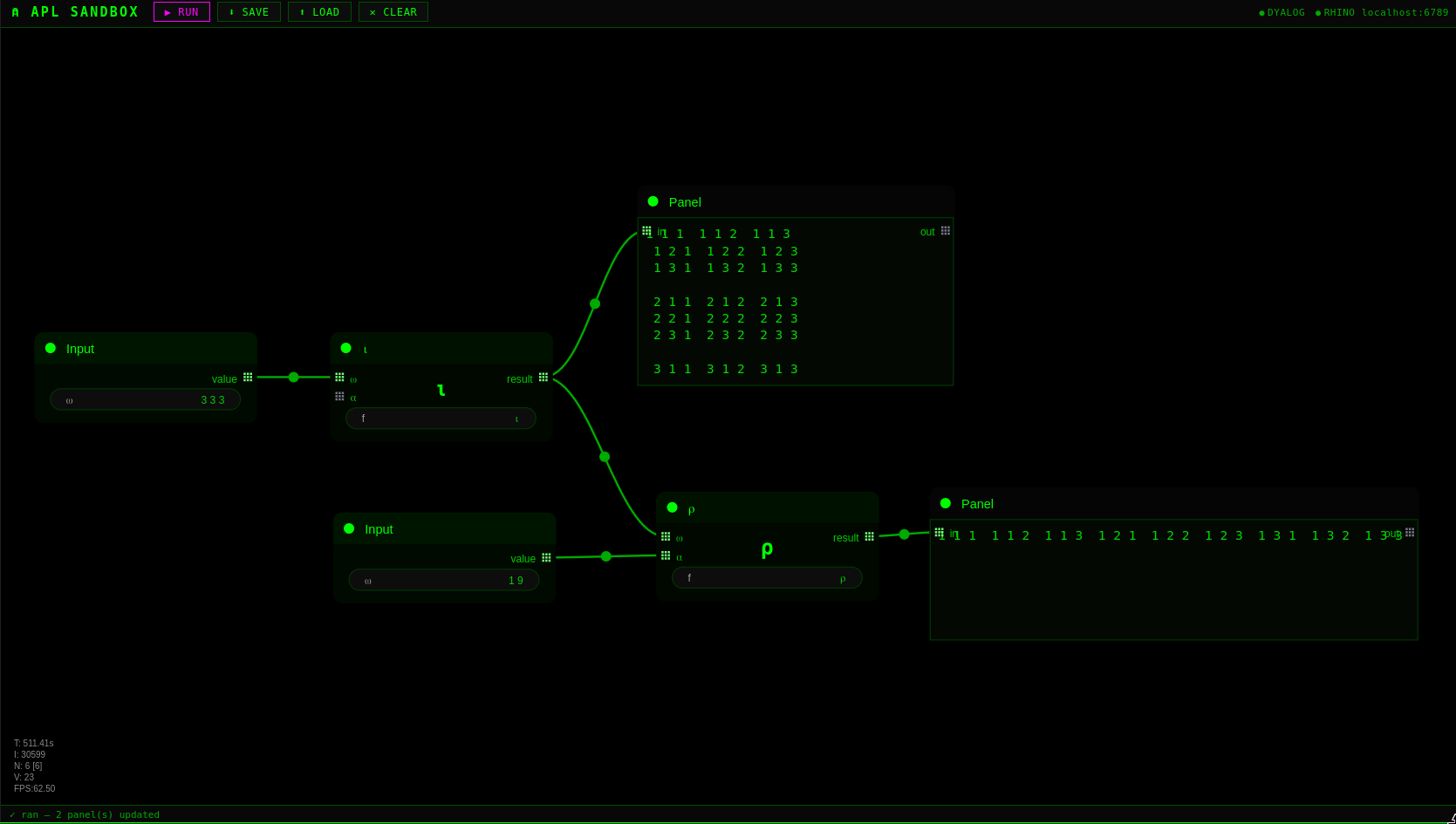
I am a long time user of a programming environment called Grasshopper in the Rhino3d modeling program. It uses a node-based graph editor. And recently I realized that part of why I have been drawn to the array languages in the past few years is because Grasshopper also uses nested data structures to organize and manipulate the data.
In Dyalog APL I am still getting my head around Train Trees as a way to view the order of operations in trains, but I love the economy and poetry of how they work.
Anyway - as I learn more APL, I've always wanted more specifically graphical ways to view the results of an expression. So I thought I'd combine the two. This is APL Sandbox, a node-based graphical environment for the viewing of APL expressions.
It is fully vibe-coded at this point, and there's a lot more I would want to do to it. Change the direction to match APL's right-to-left application, with ⍺ and the result on the left and ⍵ on the right. Getting "boxing" and other visual indicators of the nature of the arrays produced going is another important one. A way to collapse two nodes into one is another item I'd like to implement. And so forth.
So, even though it's very much a toy at this point, I thought maybe some of you might be interested to see it. Enjoy!
💬 Eli: Oatmeal - kiki
I've been working on a little array programming toy for a little bit.
Published an intro blog post to it last night.
I've spent the last few years smitten by array programming, but always finding it a tad bit unapproachable outside of profoundly boring (to me) corporate contexts. I'm attracted, though, to how spiky and terse array programming is, which feels very different to me than where I usually live in JS land.
To make it more approachable, I made a little set of learning features loosely inspired by maria.cloud's approach.
You can make tiny songs with it, too.
📑 Resources
💬 Mariano Guerra: Tutuca: Zero-dependency batteries included SPA framework
There comes a point in every man’s life where he releases an open source frontend framework. That day, for me, is today.
Tutuca: a zero-dependency, batteries-included SPA framework
https://marianoguerra.github.io/tutuca/
Would love your feedback on the framework, the landing page and the tutorial
💬 guitarvydas: Little Language Case Study - Generating Code for Simple State Machines
We've spent decades building programming languages that try to do everything — general-purpose, Turing-complete, expressive, fast, safe, concurrent. ...
But the ambition to make one language handle every problem has a shadow side: it makes us reach for that one language even when a smaller, more targeted tool would serve us better.
Little Language Case Study - Generating Code for Simple State Machines
💬 Konrad Hinsen: Federated Wiki - Catalog - Malleable Systems Forum
I have written an entry on Federated Wiki for the catalog of the Malleable Systems Collective, because I believe that it deserves to be better known: Federated Wiki - Catalog - Malleable Systems Forum
💬 Dennis: WordWell — a visual word explorer
Tangentially related, but made a visual word explorer that shows you 'interpolated' words or phrases between 'wells' of meaning on a canvas. You can play with it at wordwell.so
📑 Resources
💬 Tom Larkworthy: Parametric SVG
A Feelings of Computing one.
This is the 2nd time I have returned to the idea of using inverse kinematics to manipulate graphics. But I have moved to plain SVG now, thinking that that is somewhat of a universal representation.
And the new thing is reflecting on a reactive dataflow graph to discover parameterization automatically, and also extracting the params -> svg from the computational graph automatically, so the author only has to write parameterized SVG, and choose location of drag anchors, and the system can figure out how the anchors related to the SVG parameterization via numerical differentiation magically, so the drag handling is all free.
https://tomlarkworthy.github.io/lopebooks/notebooks/@tomlarkworthy_parameteric-svg.html
You can get a lot of expressivity out of this for not much investment. You can choose how your parameters affect your SVG, it can be quite weird. Not sure how to handle something like a normal drawing program though with multiple objects. I think I there is still something missing though. I generally want to make drawing diagrams easier, this is very finite dimensioned though.
📑 Resources
💬 Geert Roumen: GitHub - lemio/ReverseProjection: Project using a camera · GitHub
Reverse projection as a way to do spatial computing.
This is a demo of js-ar-toolkit5 connected to leaflet or tldraw that uses a camera to project stuff on smartphones. Inspired by dynamicland, but replacing the paper with phones and the projector by a camera. It makes the phone more a tool for creation instead of consumption and makes use of our ability to move (ourselves and our phones) around to create meaning.
Curious to learn if there is other use cases where this could make sense; currently thinking more about brainstorms or museum exhibitions where visitors can contribute to the exhibition and what other experiments are done in this space.
The source code can be found there https://github.com/lemio/ReverseProjection and can just be tested when ran on a laptop and a phone. The source code is very vibe coded; more to get a working result than to make it ‘good’.
Multiple phones does not work reliably at the moment, but is on my todo list; other types of hardware like a bluetooth keyboard with some marker would also be cool; so it becomes easier to ‘type in space’.
two-minute-week
💬 Tom Larkworthy: RISC-V Linux BusyBox Single Board Computer
The easter holidays I got sick and vibe coded a
RISC-V Linux BusyBox Single Board Computer
https://tomlarkworthy.github.io/lopebooks/notebooks/@tomlarkworthy_linux-sbc.html
in a single HTML file. Its quite different to Fabrice's jslinux, it is a JS emulator of the Risk V instruction set, rather than a WASM emscripten toolchain approach.
I wanted to understand the linux boot process. Vibed with my new Claude code plugin for notebooks which is incredibly productive albeit still with a fair few rough edges.
📑 Resources
👨🏽💻 By 🐘 @[email protected] 🦋 @marianoguerra.org
💬 Not a member yet? Check the Feeling of Computing Community
✉️ Not subscribed yet? Subscribe to the Newsletter / Archive / RSS
🎙️ Prefer podcasts? check the Feeling of Computing Podcast